On the Tibetan Plateau, over 2,900 meters above sea level, China built the world's largest photovoltaic park on a desert that was almost entirely sand. No one planned for the fact that, a few years later, they'd need tens of thousands of sheep just to keep the grass under control.
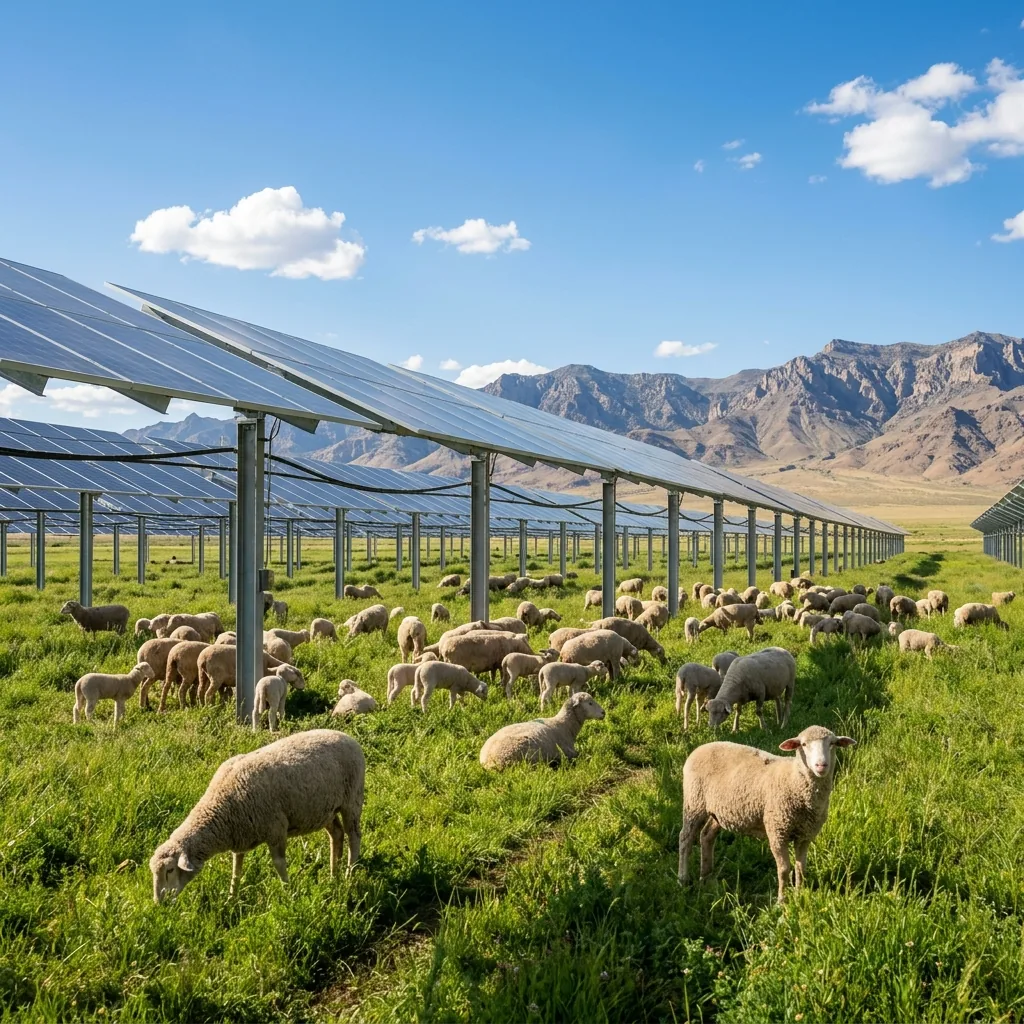
Talatan Solar Park sits in Gonghe County, Qinghai Province, on the Gobi Desert section of the Tibetan Plateau. Before construction, the area's desertification rate reached 98.5% — mostly sand, constant wind, and degraded soil. Construction began in 2012, with the specific goal of generating clean electricity at scale. No one built it to regenerate the land; that was a side effect nobody saw coming.
Without meaning to, the panels started acting as an ecological shield. They break wind force at ground level, cast shade that reduces evaporation, and the water used to clean the modules seeps into the soil instead of disappearing. The result: soil moisture under the panels rose 75%, and soil quality moved from "poor" to "general" on the scale Chinese technicians use to rate land condition.
Within just three years, vegetation cover under the panels reached 80%. Grass grew so tall — over a meter in some areas — that it became a logistical problem: it threatened to cover the panels and posed a fire risk. The solution wasn't mechanical or chemical: it was sheep.
Today the region has 32 "photovoltaic eco-pastures" and 56 centralized grazing sites within the park, supporting 18 surrounding villages that raise more than 20,000 sheep a year. A herder interviewed by Chinese state media, identified as Yehdor, went from earning about 20,000 yuan a year before the project to close to 100,000 yuan (~$14,000 USD) today. Collectively, the model generates over 10,000 yuan (~$1,400 USD) per 0.07 hectares used for grazing, and is estimated to have helped lift 173 nearby villages out of poverty.
The park covers 609 km² — the largest of its kind in the world — and, as of March 2026, has 21 GW of installed capacity, generating more than 18,000 GWh of clean electricity per year. What started as a purely energy-focused project ended up also becoming an industrial-scale land regeneration case study.
At Biosolar Agrivoltaica we apply the same principle that made Talatan possible: elevated solar panels don't have to compete with life in the soil — they can protect it. It's exactly the model we're aiming to replicate in our own projects, including the one we're developing in Argentina. If you own arid or degraded land and want to evaluate its potential, let's talk about your land.
Sources: Wikipedia — Talatan Solar Park, People's Daily, IOPscience — Ecological synergy on the Qinghai-Tibet Plateau.