If you own arid, degraded, or underused land, the question isn't just "what's it worth today?" but "what could it produce?" Here's a data-backed look, with an illustrative model on 10 hectares, at how an agrivoltaic project changes that equation.
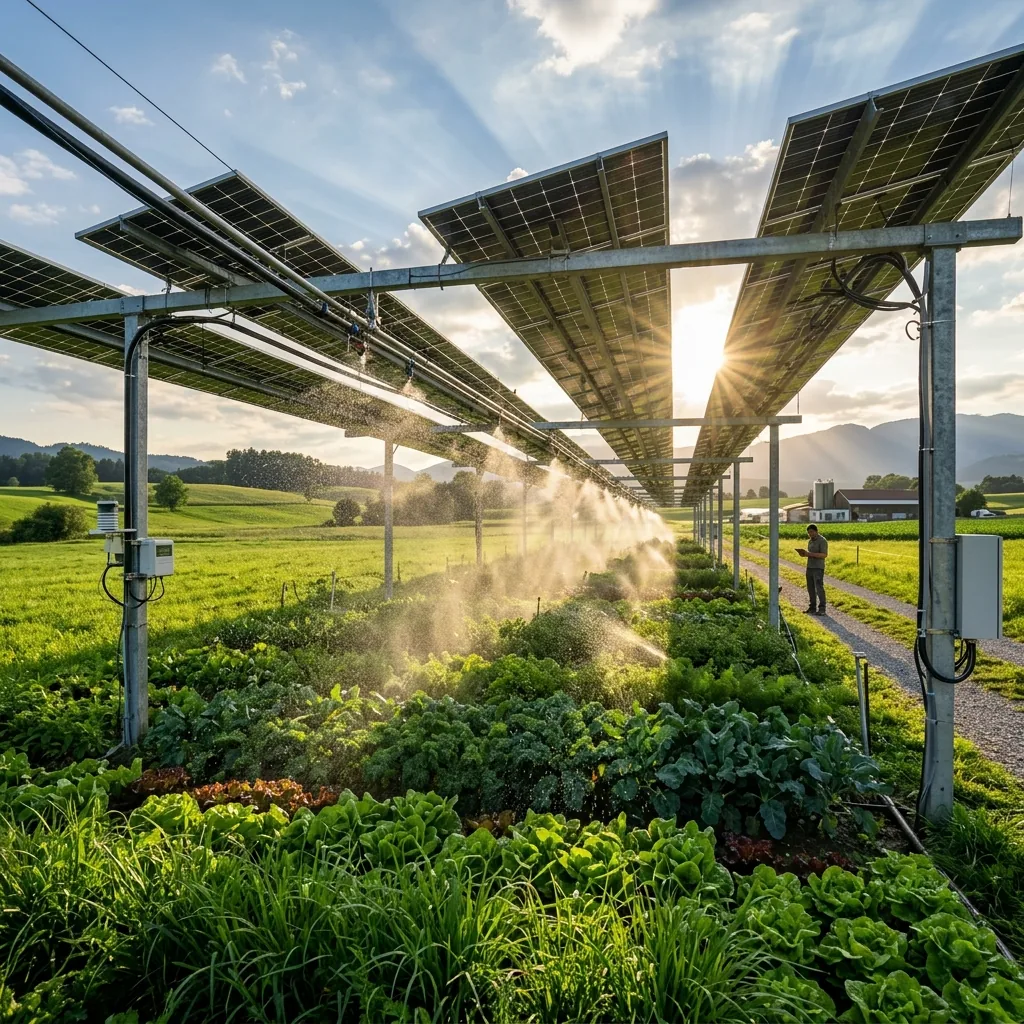
An unused arid field generates no income and often keeps degrading over time. Agrivoltaics flips that logic: studies document up to 60-70% higher combined productivity compared to running separate solar and agricultural plots, with cases reaching 186% land-use efficiency for shade-tolerant crops. Panel shade reduces soil evapotranspiration by 14% to 50% depending on the region, and the cooling effect from vegetation can lower module temperature by up to 10°C, making them more efficient and durable. On top of that, land lease income in developed markets runs $300 to $2,000 per acre per year, plus 10-30% in operational cost savings.
To make these numbers concrete, we built an illustrative model on a 10-hectare plot. Important: this is a reference exercise using industry data, not a guaranteed projection — every piece of land requires its own feasibility study.
Installation density. Utility-scale agrivoltaic projects are typically installed between 200 and 600 kW per hectare, depending on the structure design and the crop or grazing needs underneath. A 4 MW project on 10 hectares equals 400 kW/ha, within that typical range.
Estimated generation. With a typical solar capacity factor (which varies with local irradiation, roughly 15% to 25%), a 4 MW plant can generate on the order of 7,000 to 8,500 MWh of clean electricity per year — roughly equivalent to powering 600 to 700 homes (a US-based reference; the real figure depends on local electricity consumption).
Estimated environmental impact. That generation could avoid on the order of thousands of tons of CO₂ per year compared to fossil-based power, though the exact figure depends on the grid mix being displaced in each country.
The land stays land. Unlike a traditional solar farm, most of the 10 hectares remains available for sheep grazing or shade-tolerant crops, thanks to the elevated structure height (between 2.5 and 4 meters).
The typical path includes a technical and legal feasibility study of the land (irradiation, topography, land tenure), an interconnection study with the nearest electrical grid, elevated structure design adapted to the agricultural or livestock use planned for the land, the relevant environmental and municipal permits, and finally construction and installation. In parallel, the agricultural component gets defined: which crop or grazing scheme coexists best with the partial shade of the panels in that specific region.
Once operational, the generated energy can be sold in two ways, often combined. The first is direct sale to the electrical grid. The second is through a PPA (Power Purchase Agreement): a long-term contract, typically 10 to 20 years, where a private company commits to buying the generated energy at a fixed, pre-agreed price.
More and more companies sign PPAs to meet corporate sustainability targets and, above all, to protect themselves from long-term energy price volatility — it gives them cost predictability for a decade or more. For the project, a PPA provides the revenue certainty that's often key to securing financing. There are two variants: the physical PPA, where energy is actually delivered to the buyer's facilities through the grid, and the virtual (or financial) PPA, where no physical delivery happens — instead, the parties settle financially based on the agreed price versus the market price.
A well-designed agrivoltaic project doesn't replace the agricultural use of the land — it enhances it and adds energy income on top. The land regenerates through shade and reduced evapotranspiration, food or forage keeps being produced under the panels, and a stable income stream runs for 10 to 20 years through energy sales, whether to the grid or through a PPA with a private company.
If you own land and want to know what model applies to your specific case, you can request a free feasibility study. Let's talk about your land.
Sources: Berkeley Lab — Land Requirements for Utility-Scale PV, pv magazine, SEIA — Solar Power Purchase Agreements.